- +255 758509361
- info@nessdreamsafari.com

Serengeti National Park
Introduction to the Serengeti
Serengeti National Park is one of the most iconic safari destinations in Africa, located in northern Tanzania. Covering an area of 14,763 km² (5,700 sq mi), the park extends across the eastern Mara Region and northeastern Simiyu Region. It protects more than 1.5 million hectares (3.7 million acres) of natural savanna and was officially established in 1940.
The name Serengeti comes from the Maasai word Siringet, meaning “the place where the land stretches forever.” The Maasai people have lived across these vast plains for more than 200 years, long before European explorer Oscar Baumann first documented the area in 1892.
Why Serengeti National Park is Famous
The Serengeti is famous worldwide as one of Africa’s leading tourist destinations, attracting travelers because of its breathtaking landscapes, abundant wildlife, and rich cultural heritage.
Key highlights include:
The Great Wildebeest Migration, the largest overland migration on Earth.
One of the largest lion populations in Africa, together with cheetahs, leopards, elephants, rhinos, and buffalos.
Endless savannas and acacia-dotted plains that provide excellent opportunities for photography and game drives.
Despite its popularity, the park continues to face challenges such as deforestation, population growth, and pressure from ranching activities.
The Great Wildebeest Migration
The Great Wildebeest Migration is the Serengeti’s most spectacular natural event and the longest overland migration in the world, covering nearly 800 km (500 mi) each year.
January–March: Around 500,000 wildebeest calves are born in the Ngorongoro Conservation Area.
March–May: As the dry season begins, herds of 1.5 million wildebeest, 250,000 zebras, and thousands of gazelles and elands start moving north.
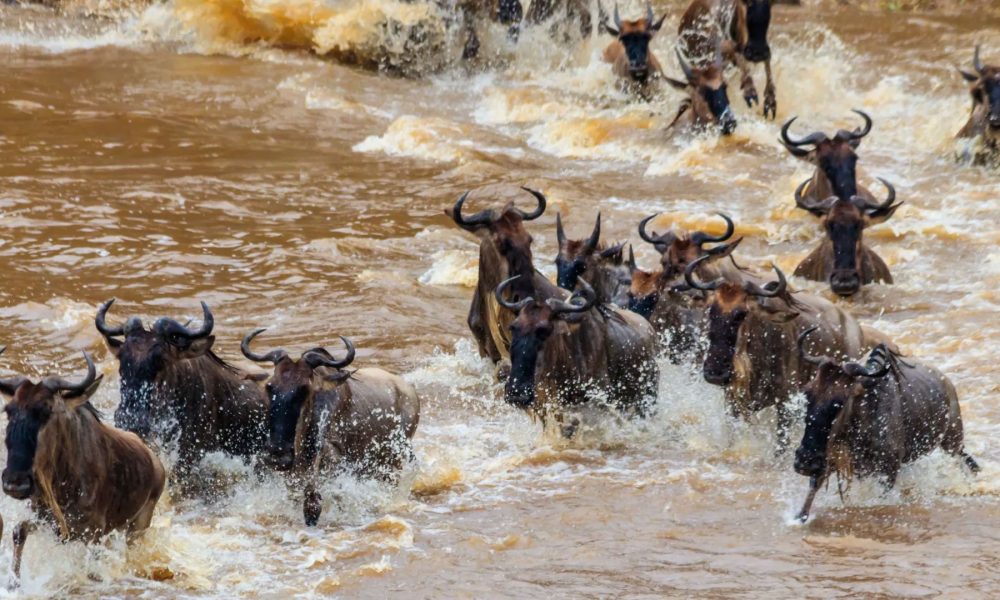
April–June: The herds move through the Western Corridor, facing dangerous crossings of the Grumeti River, where crocodiles await.
July–October: The herds cross the Mara River into Kenya’s Maasai Mara, creating another dramatic and dangerous stage of their journey.
October–December: When the rains return, the herds begin moving back south, completing the migration cycle.
Every year, up to 250,000 wildebeest and 30,000 zebras die due to predation, drowning, exhaustion, or disease. This highlights the difficult reality of survival in the wild.
Activities in Serengeti National Park
A safari in the Serengeti offers more than just game drives. Visitors can enjoy a variety of activities, including:
Guided nature walks and classic game drives
Scenic hot air balloon safaris over the plains
Bush meals and picnics in the wild
Visiting the Serengeti Visitor Center for educational exhibits
Exploring historical sites such as Olduvai Gorge
Excursions to the nearby Ngorongoro Crater
Observing the Great Wildebeest Migration
Camping in designated areas under star-filled skies
Exploring wildlife-rich areas such as Lobo Valley and Bologonja Springs
Cultural visits to Maasai villages
Best Time to Visit the Serengeti
The Serengeti offers excellent game viewing throughout the year, but the best times to visit are:
January–February: Calving season, when wildebeest give birth across the southern plains.
June–October: Peak of the dry season, providing some of the best opportunities to witness dramatic river crossings.
The park’s open plains and mild climate provide good visibility of wildlife throughout the year. Even during the short rainy seasons in November–December and March–April, safaris remain enjoyable because rainfall is usually brief and does not significantly disrupt travel.
Do you need help?
Send us details
Ness Dream Safari is a tour and safari company established to deliver an enriching responsible African holiday experience for their customers.